 |
 |
||||||||||||||
|
|||||||||||||||














|
|
|
|
 |
|||
|
|
|||
 |
|||
|
|
|
Reading Cat Food LabelsOf course, you want your cat to be healthy and happy for as many years as possible. Other than not letting her play in traffic, probably the most significant variable, that you can control, is your choice of a cat food. How do you decide? Do you feed her the food that cats ask for by name, according to the television commercial that Del Monte puts out for its Meow Mix? Do you feed her Iams, often marketed as a premium cat food? Is life truly better with Iams, as its logo suggests, or is it just not as long? How about Hill's Science Diet, the premium cat food that veterinarians recommend? What else is there? There are others, you know - so many, in fact, that choosing between them can be intimidating, and there is little to go by, since your cat doesn't generally let you know when she's not eating right. You might also argue that you've been feeding store brand cat foods to your cats for years, and they seem to be perfectly healthy. You're probably right, as far as it goes, but I'll wager that very few of you can say that you've been feeding a bargain brand of cat food to your cat for twenty years. While I'm sure that someone will step forward to make that claim, for the most part, the cats who survive to their twenties and thirties have enjoyed a good quality premium food for at least a large portion of their lives. The exception is not the rule. What to look forLet's assume that you've made the decision to feed your cat a premium cat food, a decision that will, by the way, rule out Meow Mix, since it's one of the worst choices you could make, the first four ingredients being ground yellow corn, corn gluten meal, chicken by-product meal, soybean meal; three of the four being non-nutritious fillers, while the chicken by-product meal is not the same as chicken. There is no one premium brand that is best for every cat. No single brand is guaranteed to give your cat the shiniest coat, the brightest eyes, and the most energy; nor can I name one premium brand that will assure your cat of living a long and happy life. Cats are individuals, just like people. While all four of our cats are doing well on Blue Spa Select, that wasn't true when we were feeding them a cheaper brand, and wouldn't necessarily be the case with four different cats. A quality food that three cats do very well on could still lead to gastrointestinal upset in a fourth. Ingredient listIn choosing between the premium brands, compare the labels. Carefully examine the ingredient list on the back, or side, of the bag. Corn, wheat, and soy are often used as fillers, even though cats needs very little carbohydrates in their diet. Economy brands, such as Meow Mix, use more carbohydrate filler in their products, resulting in cats having to eat much more of the product than they would if they were given a higher quality food. In the long run, this may prove to be more expensive, not easier on your wallet, than a good premium brand would be, and it is likely to result in serious health consequences for your cat. Examining the ingredient list, determine the source - not just the percentage - of protein. Protein can come from a variey of sources, including plant matter. Since cats are carnivores by nature, the better choice will be one in which the bulk of the protein is derived from meat, fish, or poultry products. The order of the listing of ingredients, by law, is based on their percentages in the food, from the greatest to the least, so it's best to look for diets with meat products making up at least three or four of the first six listed ingredients. Definitions
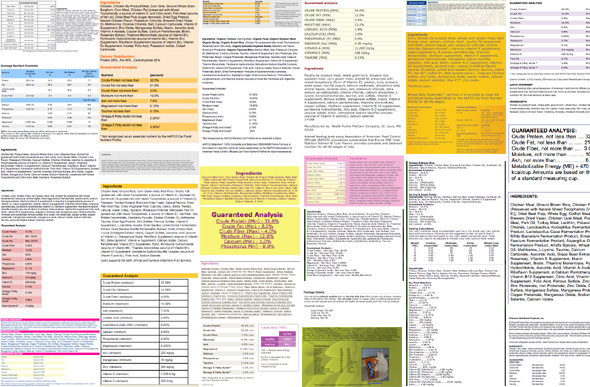
Reading labelsLabels differ from brand to brand, and can be hard to understand. However, many cat food manufacturers have adopted standards developed by the Association of American Feed Control Officials (AFFCO). Check to see that a cat food manufacturer is using the AFFCO standards; otherwise, any comparisons that might be made from reading the labels on the cat food should be suspect. AFFCO product names95% ruleNinety-five percent of the product must be the named ingredient, of animal origin, not counting water added for processing. If more than one item is named, then the combination must total 95%, with the first named ingredient of a higher quantity than the second. Counting any added water, the named ingredients must still comprise 7O% of the product. For example, if a cat food is named "Chicken for Cats", then 95% of the food must be made up of chicken; while 95% of a cat food labeled "Chicken & Liver Cat Food" must consist of chicken and liver, with the percentage of chicken being higher than the percentage of liver. 25% rule (dinner rule)When a cat food is referred to as a dinner, platter, entree, nuggets, or formula, then twenty-five to ninety-five percent of the food must consist of the named ingredient, not counting water added for processing. If more than one ingredient is named, then the second named product must equal at least 3% of the total weight. Examples would be "Chicken Dinner for Cats" or "Chicken Formula Cat Food". 3% rule (with rule)At least three percent of the named ingredient must be used in the product. As an example, if a product is referred to as "Cat Food with Chicken", the chicken must make up at least 3% of the total weight. Flavor ruleUnder the flavor rule, no specific percentage is required, but the product must contain an amount sufficient to be detected, using animals trained to prefer specific falvors. The actual ingredients used may or not actually be the named ingredient, and could be some other substance that has the characteristic flavor of the named ingredient. In other words, a cat food that claims to be "chicken flavored" may well contain no chicken at all. A good way to verify the product names is by reading the ingredient list, as all ingredients are required to be listed in order of their predominance by percentage of the total weight. Ingredients that are on the labels should appear in the ingredient list according to the rule applied. Roughly 9O% of the total weight of the cat food is made up of the first three ingredients named on the label. What the labels may not revealPlump chickens, tender turkey, fresh grains, and wholesome meals for your cat - these are the images that the advertisers want you to accept, but not all cat food manufacturers are the same. Cat food manufacturers have differing standards relating to the freshness of the ingredients they use to make their cat food products. Some manufacturers may choose to cut costs by using the cheapest ingredients available at the time that the cat food is made. Since costs rise and fall, the manufacturers might vary the ingredients from batch to batch, resulting in differences in nutritional value and quality. As a consumer, you can't determine the freshness or quality of an ingredient by reading the label, so you must trust the pet food manufacturer to use quality ingredients, and to produce cat food that is good for your cat. A good beginning is to choose a brand that puts its company's reputation on the line for the products they sell by making these claims, in writing, on the cat food that they sell, or in their printed advertising. While legal standards may be loose, a cat food manufacturer is expected, under the law, to live up to whatever claims it makes, so you're better off to select one that makes these claims in writing, preferably on their packaging. Guaranteed analysisThe guaranteed analysis on the cat food label lists the minimum levels of crude protein and fat, the maximum levels of fiber and water, and some other variables. The protein and fat are listed as crude sources, rather than as digestible sources. The digestibility of protein and fat can vary widely depending on their sources. The list of ingredients should be examined closely to determine how digestible the sources are, remembering that cats are far better able to digest and use protein that is derived from animal, rather than vegetable sources. The other factor in determining actual protein and fat percentages is the amount of moisture present in the food, as will be discussed later. While the guaranteed analysis is a good start in being able to understand the quality of the cat food, and to make comparisons, be very careful about relying on it too much. Pioneering veterinarian, Dr. Mark Morris, illustrated that pet foods are assessed by their chemical content rather than by the ingredients used to achieve these levels. In order to market something as a pet food, four categories must be included on the label: crude protein, crude fat, crude fiber, and moisture. What constitutes these levels? Pretty much anything, as Dr. Morris demonstrated in his “Dr. Morris’s blend,” which used the following four ingredients:
With this preposterous recipe, he showed us that the important thing to look for in a cat food are the raw ingredients, not the chemical composition. In real life examples, what passes for protein is often ingredients that cannot be easily digested, and which, therefore, is not made available to the cat’s cells. This may include disgusting by-products derived from animal sources that we wouldn’t knowingly feed to our pets. These protein sources may include by-products such as feathers, beaks, cartilage, lungs, and other indigestible materials, such as poultry fat made from rejected chicken parts. Cat foods may also include by-products of grains such as wheat and corn, are not digested by cats. Wheat middlings, brewers rice, and soybean meal, which make up the bulk of many cat foods, are really nothing but filler, often consisting of bits and pieces of stalks, bran layers, outer coverings, and broken grains that are not digestible. Most pet foods also use rendered poultry or beef fat, often derived from 4-D (dead, dying, diseased, or disabled) sources, which require harsh preservatives in order to prevent the fats from becoming rancid. So don’t be overly impressed with a high protein content, unless the ingredient list looks like something you wouldn’t mind feeding your cat. The guaranteed analysis is a chart listing the percentages of various ingredients contained in the food. However, the numbers listed in the guaranteed analysis don't take into consideration the amount of moisture in the food, which will differ greatly from one cat food to another. Canned foods can have up to 8O% moisture, while dry foods can have as little as 6%. To determine the actual amount of an ingredient in a food, or to compare between brands, and particularly between wet and dry foods, the numbers need to be converted to what is called dry matter basis. Converting dry matter basisThis can be the difficult part. All pet foods have different levels of moisture. Canned foods can have up to 8O% moisture whereas, some dry foods can have as little as 6%. This is important for two reasons. The first is that the food is priced by the pound, and when you buy cat food that is 8O% water, what you're getting is 2O% food, while the rest is water. So, with canned food, the amount of food that your cat consumes is small, and the price more costly. The other reason for understanding the moisture percentage is to help you compare crude protein and fat between brands, and between canned and dry cat foods. The listings on the label are for the food as it is, not as it would be on a dry matter basis. So without converting both brands of food to a dry matter basis you will not be able to compare them accurately. The conversion itself is not that complicated. If a dry cat food has 1O% moisture we know that it has 9O% dry matter. So we look at the label and check the protein level that reads 2O%. Next, we divide the 2O percent protein by the 9O% dry matter and we get 22%, which is the amount of protein on a dry matter basis. Now let us compare this to canned food that has 8O% moisture. We know that with 8O% moisture we have 2O% dry matter. The label shows 5% protein. So we take the 5% and divide it by 2O% and we get 25% protein on a dry matter basis. So the canned food has more protein per pound on a dry matter basis after all of the water is taken out. You can do the same for fat, fiber, and all of the other listed variables. Stage of lifeMake sure that the food you ultimately select is approprite for your cat's stage of life. An adult cat may become overweight if fed a diet intended for a growing kitten, while a kitten needs the extra calories, protein, vitamins, and minerals that are typically found in a kitten formula, and older cats might do better with a food that has fewer calories, and is more easily digested. On the upper end, at least, it's best to use your cat's activity levels as a gauge rather than her chronological age. For example, even at the age of twenty-three, I wasn't feeding Baby Girl a senior formula; first, because it's difficult to accomplish this when you have five cats ranging in age from six to twenty-three, but, more significantly, because, even at that advanced age, she was as active as any of them up until the time that her cancer interfered with her ability to eat. Her twin daughters will be seventeen in December, yet they are both eating a regular adult formula. TransitioningHopefully, by now I have persuaded you to spring for a premium brand of cat food for your pet, as your cat will do better with it, and you'll save money in the long run. Some cats have no problem at all switching from one cat food to another. Mine are always excited to try something new, although Bird sometimes has trouble digesting a new food properly, evidenced by vomiting. Normal bacteria in the intestine help your cat digest its food. A sudden change in her diet can lead to changes in the number and type of these bacteria, making it more difficult for her to digest her food, resulting in intestinal upset. To reduce or avoid problems, switch to a new food slowly, over a period of ten to fourteen days. Start by mixing 25% of the new food with 75% of what she was eating before, feeding that for at least three days. If everything goes well, increase the percentage to 5O% of each type of food for three days, then 75% new and 25% old for a few days. Within a couple of weeks, your cat should be transitioned to the new food. When we transitioned our four cats from Hill's Science Diet to Blue Spa Select, one of our cats - Cutie - was picking out the Spa Select from the start, leaving the Science Diet behind for the others. It took Bird about ten days to make the transition, but she's always had a more sensitive stomach; plus, having been a stray, she has some food issues, and tends to overeat sometimes.
|
|
|